First of all, thank you to everyone who reached out to me after my Mother’s Day post. I was touched by the outreach of so many and glad that something I wrote could resonate with some of you. I was not expecting that, and it is always very meaningful. This post will be more “ME specific”, but as always, I appreciate anyone willing to learn a bit more about this disease and the challenges faced by those dealing with it.
I am going to attempt to explain something that I myself am still learning about: the difference between ME and CFS. That is probably a little confusing to those who have read a few of my posts. ME vs CFS? I thought you had ME/CFS? Well yes, my official diagnosis is ME/CFS because that is what the medical community has decided to call my illness. Except there are different diagnostic criteria for ME when compared to CFS. If you want all of the details, you can check out the ME International Consensus Primer found here. It is much more comprehensive than what I can write about here and also includes references to a fair amount of research. It also explains why CFS is not the correct diagnosis for someone with my disease and why ME is the proper term and should be exclusively used.
Chronic Fatigue Syndrome is a categorically terrible name for a disease. I have heard it compared to calling Alzheimer’s disease “chronic forgetfulness syndrome” or Parkinson’s disease “chronic shaky syndrome”. It takes one symptom from a complicated and devastating illness and trivializes it to the point it is almost comical. Comical if it hadn’t lead to so much damage in the perception of this disease that is. That does not even get at why having different diagnostic criteria for ME and CFS and then lumping them into one illness is a bad idea. This problem is clearly identified in the primer I linked above:
“The label ‘chronic fatigue syndrome’ (CFS), coined in the 1980s, has persisted due to lack of knowledge of its etiologic agents and pathophysiology. Misperceptions have arisen because the name ‘CFS’ and its hybrids ME/CFS, CFS/ME and CFS/CF have been used for widely diverse conditions. Patient sets can include those who are seriously ill with ME, many bedridden and unable to care for themselves, to those who have general fatigue or, under the Reeves criteria, patients are not required to have any physical symptoms. There is a poignant need to untangle the web of confusion caused by mixing diverse and often overly inclusive patient populations in one heterogeneous, multi-rubric pot called ‘chronic fatigue syndrome’. We believe this is the foremost cause of diluted and inconsistent research findings, which hinders progress, fosters scepticism, and wastes limited research monies.”
The diagnostic criteria for CFS are quite wide. You basically need to have had more than 6 months of prolonged and unexplained fatigue along with some additional symptoms that may include (but do not have to include): pain, post exertional malaise (PEM), orthostatic intolerance and/or sleep disturbances. I fit all of the criteria for CFS (including all of the “optional” criteria), but I also fit all of the diagnostic criteria for ME, which are far more specific and actually compulsory for a diagnosis. In order to be diagnosed with ME, you must have: 1) Post-Exertional Neuroimmune Exhaustion 2) Neurological Impairments 3) Immune, Gastro-intestinal & Genitourinary Impairments and 4) Energy Metabolism/Ion Transportation Impairments. You can see that these two conditions are not necessarily the same thing. You could meet the criteria for CFS but not meet the criteria for ME. As stated in the primer, this has lead to confusion as to what should be researched in terms of treatments and if treatments that help those with CFS will help those with ME.
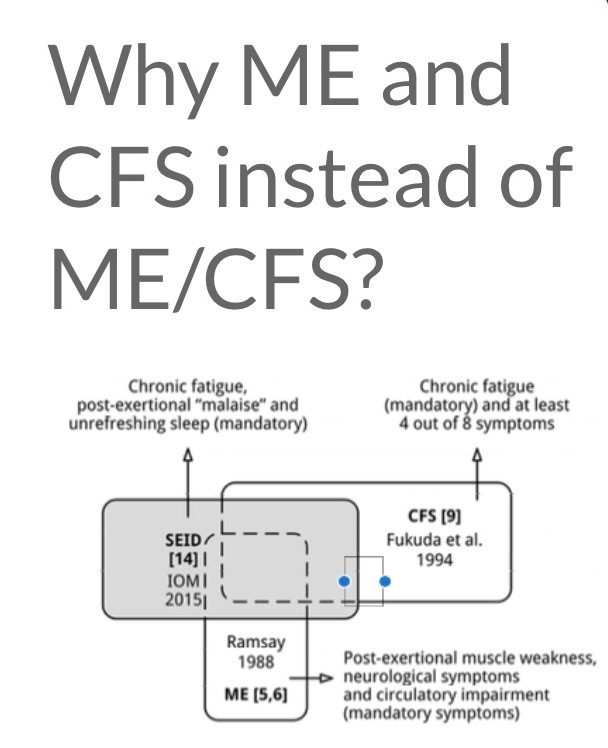
There are some very stalwart activists who abhor the use of ME/CFS and will not stand to listen to any researcher, doctor or expert that uses this phrase. I get where their frustration comes from, but I also understand that ME/CFS is the widely accepted and used diagnosis of what is recognized as ME in the United States. All of my doctors use ME/CFS. What I do get upset over is people just using CFS. I do not say that I have “chronic fatigue syndrome” and do not appreciate when this term is used to describe me. It has so much negative baggage attached to it and often times does not even describe the illness that I am experiencing.
I do not mean to say that those who just meet the criteria for CFS are not suffering. I am quite certain that they are! Feeling exhausted all of the time is well…exhausting! But trying to lump these two things together and treat them the same is doing a great disservice to people with both conditions. Something that helps someone diagnosed CFS but not ME will, under most circumstances, not help me. This leads to some rather frustrating interactions where someone will know someone diagnosed with CFS and think they have my cure in hand (refer to my past blog post entitled “You should Try”). Again, I know that most people offering advice or anecdotal evidence for improvement are coming from a kind place. But please understand that this diagnosis is so challenging to nail and that ME is so vastly misunderstood by the medical community. Unless you have my test results and your friend’s test results side by side, accounting for all of my co-morbidities and the fact that ME and CFS do not always mean the same thing, I can struggle to take these anecdotes as they are intended. When you have so little mental and physical energy to begin with, trying to explain this without coming across as rude or dismissive can be challenging. And believe me when I say that the last thing I want people to feel when they take an interest in my health is dismissed.
I often get asked what symptoms I experience by kind and inquisitive people, and I thought this might be an addition to this post that could fit. What do people with ME (or ME/CFS if you must 😉) feel like? Now I am not the source of truth for all people with ME. I am sure people have symptoms I do not, but this is my experience with the disease:
Fatigue is obviously the first thing that comes to mind. I am utterly exhausted all of the time. And this isn’t “I pulled an all-nighter” kind of fatigue. It is incredibly challenging to describe to someone who hasn’t experienced the kind of fatigue brought on by chronic illness. It feel like my limbs are made of cement. Getting off of the couch takes thought, preparation, planning permits. I have to rest after taking a shower. Emptying the dishwasher. Walking down the stairs. Writing this post is draining me. I don’t say all of this for sympathy or pity. I am just trying to impress on any healthy person reading this that when you say you are tired, it is not the same thing as an ill person saying they are tired. Being mindful of this will make you a more empathetic person. To any ill person reading this, I see your struggle. Resting is productive and you do not need to feel guilty about it. Stop holding yourself to the same standard you did before you got sick.
I experience widespread and constant pain. It is worse in my neck, back, knees and hands and then runs along my shins and into my feet and ankles. I get migraines nearly every week and have headaches almost every day (both helped with medication, thank you medicine!). I feel dizzy and unsteady on my feet. I am supposed to have a shower chair because of my POTS. The shower is dangerous game of “will she or won’t she” as I attempt to stay on my feet and not fall out of the bathtub as my blood pressure plummets. I have yet to invest in said chair becauuusee I still have my pride, okay?! I am sensitive to light, sound, and smells. I love perfume and end up making myself sick most of the time when I stupidly spray it on. If I am not taking my medication, I am constantly nauseated. I will burp incessantly and vomit. I have a face rash that comes and goes. My heart will race like crazy, and I have the uncomfortable feeling of my heart beating in my throat for no reason. My HR will jump from the 70’s while laying down to in the 120’s while brushing my teeth. This isn’t an exhaustive list, but it does give you some idea of what is going on behind the keyboard. And I hated typing that all out. It makes me feel like SUCH a whiny baby. But if it helps someone else with ME see their symptoms in another person, there you go.
I so appreciate anyone reading this blog. I am still stunned at the number of people who take the time to do so. Especially posts like this one, as I know they might not be terribly interesting to those outside of my community. But I want to raise some awareness of what people with ME might face. The amount of disbelief and misconception around an extremely sick group of people has been brought about by a number of things. The confusion about the name has certainly been one of them.

 Journey through ME/CFS
I hear you and pray for you! You are my hero! Love you lots!!
LikeLiked by 1 person
It took the little girl I nannied for almost 6 years to get a POTS diagnosis and so many symptoms you described her are ones I have witnessed first hand. She was not able to finish high school because of it. She contemplated taking her life because she felt like such a burden and that she had no quality of life. She has some really high highs and some really low lows but she is 19 and so much life left to live. Her parents are with her or another caregiver is around the clock because she often goes unconscious. It has been tough financially, mentally and physically for her family to support her. It’s a really hard situation all around and for years they were brushed off and to some extent still are. They manage symptoms, but there is no “cure” or “fix”. I have been following along with your blog for sometime now and I really appreciate your honesty and openness. It’s so raw and real and having met someone who has similar experiences as you in the day to day, I sincerely pray for you. I hope that one day there is more that medicine can offer to you, both of you. (((Hugs)))
LikeLiked by 1 person